
Imagine having pure warmth in winter and a cool breeze in summer—all in the same room. Sounds like a fantasy, right? But what if I told you it’s actually possible? Yeah, you heard it right.
So, here’s the big reveal. Air source heat pumps make this comfort a reality. But, how do air source heat pumps work? It’s pretty fascinating—like harvesting the perfect temperature from Mother Nature herself.
And the best part? An air source heat pump costs less to run and maintains comfort throughout the year. What an incredible feat of technology! Let’s dive into the mechanics of how they operate in UK homes.
What is an air source heat pump?
An air source heat pump is a renewable energy system that draws in air from outside to heat a home. It uses electricity to absorb and amplify heat even at lower temperatures. Then, it uses the amplified heat for central heating and generating hot water.
In summer, the functionality reverses itself. The hot air from outside turns cooler and ensures a comfortable ambience inside. Air source heat pumps are amazing alternatives to boilers. It’s best to let qualified air source heat pump installers do the installation for optimal performance.
What are the Types of air source heat pumps?
Two main types of air source heat pumps are available-
Air-to-water heat pump: Heats the home by warming radiators or underfloor heating systems. It also supplies hot water for domestic use.
Air-to-air heat pump: Functions like an air conditioner that blowing warm air to keep the home comfortable. It does not provide hot water.
How do air source heat pumps work?
Air source heat pumps stand out because they don’t rely on burning fuels to generate heat. Instead, they pull in outside air, warm it up through a refrigeration cycle, and circulate it inside. Wonder if they can produce heat from the cold winter air? They can — and often do, even in low temperatures.
During winter, these systems run in a reverse cycle compared to a refrigerator, while in summer they function similarly to one, cooling your home. They can both heat and cool your space depending on the season. Also, note that air-to-air heat pumps operate differently from air-to-water types.
Let’s explore how both types of heat pumps function to heat and cool UK homes:
How do air-to-air source heat pumps work?
Air source heat pumps don’t generate heat directly. They transfer heat from the outside air to warm your home, and vice versa for cooling. Here’s a look at how an air-to-air heat pump manages heating and cooling inside your house.
How an air-to-air heat pump heats:
- Absorbing heat from outside: An outdoor fan draws air in, and the refrigerant (a liquid) captures heat even in cold conditions.
- Heating and vaporisation: As the refrigerant absorbs heat, it turns into vapour inside the evaporator before reaching the compressor.
- Compressing the vapour: The compressor compresses the vapour, raising its temperature and pressure, which makes it hotter.
- Distributing warm air: The heated refrigerant then moves through the indoor unit, where a fan blows warm air into your home, often via ducting or fan coils.
- Cooling and returning: After releasing its heat indoors, the refrigerant cools and condenses back into a liquid, then travels back to the evaporator via an expansion valve.
- Repeating the cycle: Once the refrigerant has re-entered the evaporator, the cycle restarts, continuing to heat the home efficiently.
How an air-to-air heat pump cools:
The cooling process is simply the reverse of heating. Here’s how it works:
- Indoor Heat Absorption: The indoor unit acts as the evaporator, drawing warm air from inside and cooling it.
- Heat Discharge Outside: After absorbing heat, the refrigerant evaporates into a gas and releases the heat outside the house.
How do air-to-water source heat pumps work?
An air-to-water heat pump delivers heat to your central heating system and hot water tank, giving you both warmth and hot water. Here’s how it heats and cools your home depending on the outside weather:
How an air-to-water heat pump heats:
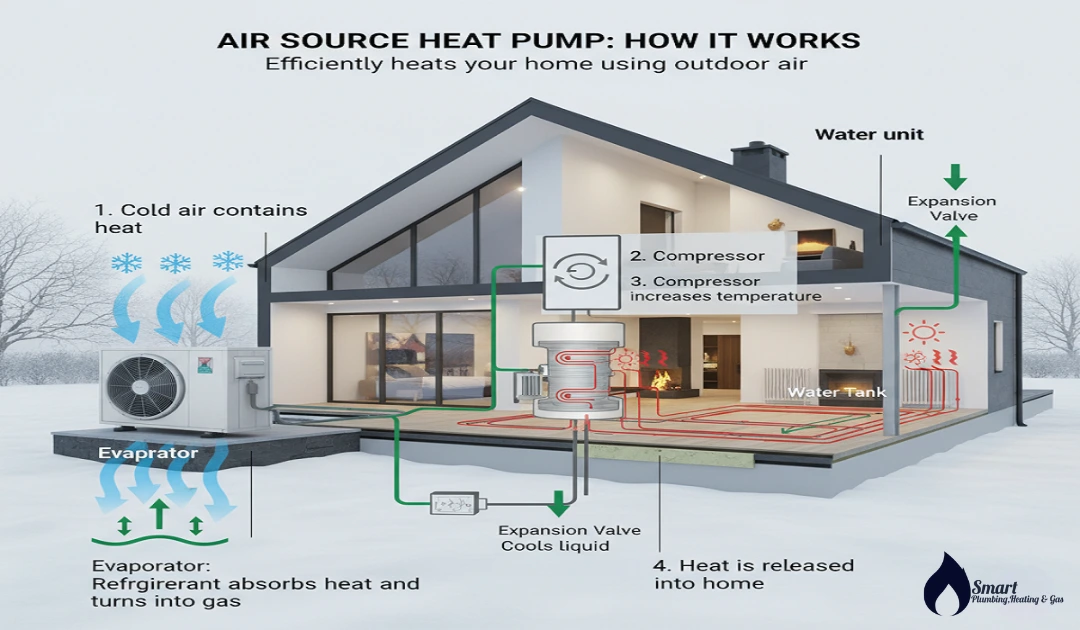
- Pulls outside air: An outdoor fan draws air from outside. Even in low temperatures, it still brings in air that contains heat.
- Absorbs the heat: A refrigerant liquid in the heat exchanger absorbs the heat from the air taken in by the fan.
- Liquid refrigerant evaporates: After absorbing heat, the refrigerant turns from a liquid into a hot gas through evaporation.
- Compresses the heat: The hot gas moves into a compressor, which increases its temperature further. This high-temperature gas is now ready to heat the house and tap water.
- Gas flows to the condenser: The compressed refrigerant gas flows into a condenser, a heat exchanger that transfers heat to the central heating system.
- Heat distribution: Once the heat is transferred, the central heating system manages radiators and underfloor heating and heats water in the hot water cylinder.
- Cycle repeats: After releasing its heat, the refrigerant cools down and condenses back into a liquid as it passes through the expansion valve. It then cycles back to absorb heat again.
How an air-to-water heat pump cools:
Cooling UK homes in summer is basically the reverse of heating in winter. Here’s a quick rundown of how it works:
- Absorbing heat from the indoor water system: During summer, the refrigerant absorbs heat from the indoor water system and the hot water cylinder.
- Heat expulsion: The refrigerant then releases this heat outside the house, leaving the water cool and comfortable.
- Cool water circulation: As the heat is expelled, the cooled water is ready to circulate throughout the house, powering underfloor heating and filling the water cylinder.
Final Words
Many people accustomed to traditional boilers hesitate to opt for a heat pump. They often ask how do air source heat pumps work, since they are still underrated. However, once they learn how they work, they tend to choose a heat pump as their primary heating solution.
Heat pumps are not only the most energy-efficient option but also emit less carbon than other heating methods. Have more questions? Contact us anytime.
FAQ- Air Source Heat Pumps Working Methods
How does an air source heat pump work step by step?
An air source heat pump pulls heat from the outside air.The refrigerant inside absorbs this heat, turns into a gas, then a compressor increases its temperature. That hot gas gives off heat to your home’s heating system, cools down, and condenses back into a liquid to repeat the cycle.
Why is my electric bill so high with an air source heat pump?
Your electric bill might be high even with an air source heat pump if your home isn’t well insulated, the system settings are incorrect, or you set the thermostat higher than necessary.
What is the downside of the air source heat pump?
Common drawbacks of air source heat pumps include higher upfront costs, the need for outdoor space for installation, and dependence on electricity.
Can you run out of hot water with a heat pump?
Yes, if your hot water tank or cylinder is too small for your household’s needs, you might run out of hot water. However, this situation is usually rare. Choose the best air source heat pumps for an optimal service.
Can a heat pump give you a hot bath on a cold day?
Definitely, it can. Studies show that heat pumps can produce enough hot water for a family’s daily needs, even during winter cold snaps.
How often should I get my heat pump serviced?
A heat pump should be serviced annually by professional heat pump installers. Doing this just before winter ensures it’s prepared for the colder months and prevents unexpected breakdowns.
