
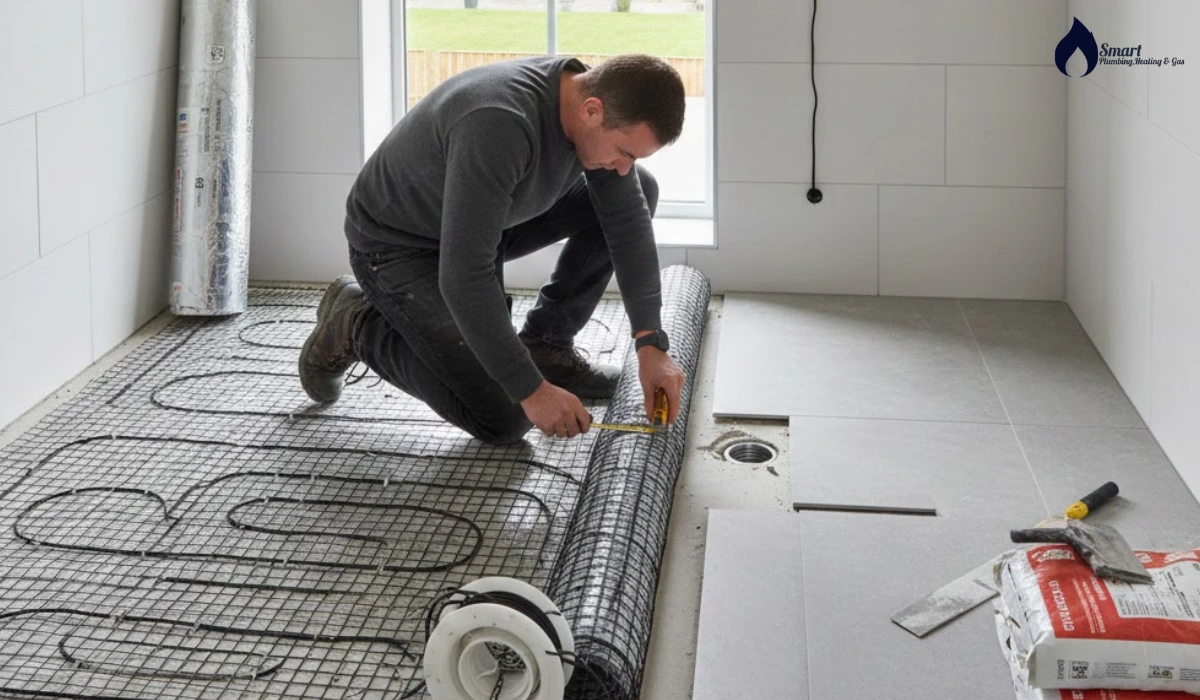
Cold mornings and freezing feet getting you down? Electric underfloor heating is your fast, efficient fix. Picture stepping out of a steaming shower onto a cozy, warm floor—no more chilly shocks! Wondering how to install electric underfloor heating? The good news is, it’s surprisingly simple and DIY-friendly.
This system heats up quickly and covers the whole room in no time. Many UK homeowners hold back because they’re unclear about the installation steps. That’s why we’ve put together a simple, step-by-step guide to help you install electric underfloor heating smoothly. Let’s dive in.
What Is Electric Underfloor Heating?
Electric underfloor heating is a dry central heating method that heats spaces using ultra-thin electric wires or wired mats. Other formats include foil layers and in-screed cable systems. Typically, these are installed on top of the subfloor, above the insulation cover, and beneath the tiles. When connected, they heat up, and the warmth gradually spreads evenly from the floor throughout the entire room.
The system works by converting electricity into radiant heat, which rises and distributes evenly upwards. A thermostat or programmer controls the system, allowing you to set and maintain your desired temperature.
Types Of Electric Underfloor Heating
Electric underfloor heating offers multiple options based on your space and needs. The main types include:
- Loose Wire System: Uses flexible wires for custom fitting, ideal for small or irregularly shaped rooms.
- Rolled Heating Mats: Mesh-backed mats suitable for larger, uniform spaces like bathrooms or kitchens.
- Foil Heating System: Cables embedded in foil, perfect for thin floors under laminate or vinyl.
- Inscreed Cable System: Cables embedded in screed, providing a durable solution for various floor coverings.
- Decoupling Mat Systems: Installed between the subfloor and finish, these mats prevent cracks and ensure even heating.
How To Install Electric Underfloor Heating? A Complete Breakdown
Electric underfloor heating installation can be a DIY-friendly project. However, you’ll still need a qualified electrician to connect the system to the mains and perform final testing. Here’s a step-by-step guide on how to install electric underfloor heating:
Step 1: Design And Measure The Layout
You need a clear plan for how you’ll lay the wires or mats. Understanding your desired layout beforehand ensures a smooth installation process.
How to Do it:
- Sketch the room: Draw a rough layout, noting measurements and the locations of permanent fixtures like sinks, toilets, cabinets, etc., based on your plan.
- Identify unheated areas: Mark zones that shouldn’t be heated. Electric underfloor heating can’t be installed under permanent fixtures because they restrict airflow, risking thermal blocking.
- Calculate the heating area: Once marked, measure the total area that will be heated.
- Leave clearance around edges: Maintain at least 40-50mm of space around the room’s perimeter. Wiring or mats shouldn’t be laid flush against the walls.
- Choose your system: Decide whether to use loose wires, mats, foil systems, or other options. This choice should depend on your room’s layout and size.
Step 2: Prepare The Subfloor
The subfloor must be properly prepared before installation. Let’s explore the steps to prepare it:
- Sweep, vacuum, and remove all debris to ensure the surface is clean.
- Make sure the subfloor is dry, level, and dust-free.
- The surface should be smooth and even. Use a leveling compound to fix major bumps or cracks.
- Prime the floor, cover the area, and allow the primer to dry completely.
Step 3: Install The Insulation Cover
Without proper insulation, underfloor heating cannot perform effectively. Installing insulation boards is essential, as they can boost the system’s efficiency by up to 50%.
How to do it:
- Lay the insulation boards in a brickwork, checked, or staggered pattern, ensuring joints do not line up.
- Secure the boards using adhesives or screws according to the manufacturer’s instructions.
- Seal all joints between the boards with plaster or scrim tape.
- Fit the insulation foam around the edges of the room.
Step 4: Perform A Resistance Test
This is the initial resistance test to verify whether the heating cable and insulation are functioning properly.
How to do it:
- Switch your multimeter to ohms and measure resistance between the live and neutral wires. Confirm that the reading aligns with the values given in the manufacturer’s datasheet.
- Use an insulation tester set to 500V to check between the live wire and ground, as well as the neutral wire and ground.
- Compare all readings with the manufacturer’s specifications. Any deviations mean the heating cable or mat could be faulty, and it needs to be replaced.
Step 5: Laying The Heating Mats Or Cables
Now, you must lay the heating mats or cables as you calculated.
How to do it:
- Start laying from the point where the power end will connect to the controller.
- To change direction or work around obstacles, cut the mesh backing with scissors. Make sure you’re only cutting the mesh, not the cable.
- For mats with a self-adhesive backing, secure them only after confirming the layout.
- If you’re using loose cables, space them at least 3-4 inches apart or maintain a minimum distance of 50mm between wires. This prevents crossing or overlapping.
- For areas with obstacles, carefully remove the cable from that part of the mesh and secure the loose edges with tape to prevent movement.
Step 6: Locate The Power Source And Cut Conduits
Step-by-step guide for installing and testing your heating system:
- Identify where the power cables will connect, then cut a channel in the insulation board to run these cables to the controller. Always perform a resistance test on the cables or mat beforehand to ensure proper operation.
- Choose a location for the power supply and thermostat that is shaded from direct sunlight.
- Mount the thermostat at an appropriate height on the wall.
- Cut a recess into the insulation board for the power cables and the flexible pipe that will house the floor sensor, ensuring it sits flush with the surface.
- Position the sensor probe between two heating cables for accurate temperature measurement. For mats, place the sensor beneath the mesh, between two cables.
- Extend the conduit from the power source to the thermostat’s location.
- Conduct a resistance test with a multimeter on the cables or mats to verify functionality before covering the surface.
Step 7: Add Coverings Over The Heating Elements
When installing heating elements (such as cables or mats), you need to decide whether to use a wet levelling compound or a dry covering.
How to do it:
- Wet Covering: Use a flexible tile adhesive or self-leveling compound/screed. This compound encases the heating elements, creating a smooth surface that protects them. We recommend applying around 3mm of levelling compound thickness. Wet coverings are ideal for tiles and stone flooring.
- Dry Covering: This method is similar to a floating floor. It typically involves a foil system placed underneath laminated floors or carpets. No adhesive or screed is required for this type of covering.
Step 8: Perform The Final Resistance Test
Use a multimeter to test the resistance of the heating cables or mats. After installing the floor covering and before connecting the thermostat, perform a final insulation test. This step ensures that no issues arise during installation and that the system is safe to operate.
Step 9: Lay The Flooring And Let It Dry
Unlike the foil system, the wet system uses screed or adhesive, which takes time to dry. However, you need to lay the flooring before it completely dries. Therefore, after pouring the levelling compound, proceed to lay the tiles.
How to do it:
- Now is the time to install your flooring. Place your desired floor covering over the levelling compound. This could be stones, tiles, or engineered wood—essentially, any flooring type compatible with UFH.
- Make sure the screed or adhesive dries thoroughly. This process can take anywhere from 7 to 21 days, depending on conditions.
Step 10: Connect The Systems And Thermostat To The Electric Mains
That is the final step—you’ll need a NICEIC-certified electrician at this stage. Let’s walk through how the process unfolds:
- The electrician will connect your heating system and thermostat to the electric mains on a dedicated circuit. They will perform final checks and provide you with the necessary electrical installation certificates.
- Once the screed or adhesive has cured and the connection is complete, you can activate your heating system. Turn on the thermostat and set it to the floor sensor. Gradually increase the temperature each day—it’s best to raise it by no more than 2°C daily until you reach your desired setting. This slow adjustment helps prevent flooring cracks and detachment.
In Conclusion
An electric underfloor installation is a relatively straightforward DIY project. While many people are still unsure how to install electric underfloor heating, this article can serve as your guide. However, remember that you should hire a qualified electrician to connect the system and ensure compliance with building codes.
So, pick your heating system and get started. If you’re unsure about the process, consider hiring professional underfloor heating installers to handle your electric underfloor heating setup.
FAQ About Fitting Electric Underfloor Heating
How Is Electric Underfloor Heating Connected?
Electric underfloor heating is normally linked through a thermostat that sits between the heating cables and the home’s electrical supply. The heating element connects to the thermostat’s load side, the mains supply connects to the mains terminals, and the floor sensor plugs into its own dedicated inputs so the thermostat can control temperature. All earth connections are bonded safely inside the back box. A qualified electrician must complete and test the installation.
How Long To Leave The Screed Before Turning On Underfloor Heating?
Allow the screed to cure for 7–21 days before switching on the underfloor heating. For calcium sulfate screed, wait at least 7 days, while sand and cement screed may require up to 21 days for proper drying.
Should You Leave Electric Underfloor Heating On All The Time?
Not necessarily. It’s more energy-efficient to keep the heating on at a low temperature continuously, rather than turning it on and off frequently.
What Goes On Top Of Electric Underfloor Heating?
Lay your chosen flooring like tiles, laminate, or hardwood, over the heating system using appropriate adhesives or levelling compounds for a secure and even finish
What Is The Best Temperature For Electric Underfloor Heating?
The optimal thermostat setting for electric underfloor heating is typically between 21°C and 25°C. For bathrooms, a slightly higher temperature around 24°C to 28°C is preferred to ensure comfort and moisture control.
How Long Does It Take For Electric Underfloor Heating To Warm Up?
Electric underfloor heating usually takes between 30 minutes and 2 hours to reach the desired temperature. The exact warm-up time depends on factors such as the flooring type, wattage, and insulation conditions.
Can I Install Electric Underfloor Heating Myself?
Yes, you can install it yourself. But a certified electrician must handle the final connection to the electric mains to ensure safety and compliance with electrical codes.
What Is The Best Flooring For Electric Underfloor Heating?
Tiles and stones are the best flooring options for electric underfloor heating because of their high thermal conductivity, which allows heat to transfer efficiently.
